Haryana has not passed a permanent ban on stilt-plus-four (S+4) floors. What has actually happened is a High Court stay on the policy, followed by a government memo freezing all fresh S+4 approvals until further notice. That distinction matters — and most people getting it wrong are the same people who’ll give you the wrong advice on your next purchase.
The S+4 policy repealed for good — no new floors, ever. That’s what the forwards claim.
The policy still stands, but fresh approvals are on hold “till further orders,” and the portals are switched off.
What is S+4, quickly
An S+4 building is a plotted, low-rise format: a stilt (an open ground level meant only for parking) with four independent residential floors above it. Each floor is usually owned and sold separately. This is completely different from a high-rise apartment society, where dozens of flats sit inside one tower on shared land.
The appeal was simple: more floors on the same plot meant more saleable units, and buyers got land-linked value with low maintenance. Builders loved it. Inventory grew.
How we got here — the honest timeline
- 2017 Haryana first allowed the S+4 format in residential areas. Builders adopted it fast across the newer sectors.
- 2018–2022 The problems showed up. In many colonies the infrastructure was never designed for that density — roads clogged, sewage systems overloaded, and stilt parking got misused (converted into rooms, shops, storage). Resident associations began protesting formally.
- February 2023 The state banned S+4 and set up an expert panel under former IAS officer P. Raghavendra Rao to study the issue.
- June 2023 The panel didn’t say “ban it forever.” It recommended allowing S+4 with riders — infrastructure augmentation, mandatory infra audits, reduced height, family-only use, and quick-response teams to curb stilt misuse.
- 2 July 2024 The Town & Country Planning Department notified S+4 again, raising the earlier stilt-plus-three cap — but only where a plot’s layout was approved for four dwelling units, i.e. a density of 18 persons per plot.
- Late July 2024 Residents (the Gurugram Citizen Council) challenged the policy in the Punjab & Haryana High Court. Multiple PILs followed.
- 2 April 2026 In Sunil Singh v. State of Haryana (CWP PIL 212 of 2024) and connected cases, the High Court stayed the 2 July 2024 policy, observing that the state appeared to have prioritised revenue over public safety while ignoring basic infrastructure realities.
- 17 April 2026 The planning department directed HSVP and the Urban Local Bodies department to act against unauthorised use, occupation or construction on stilt floors, and against encroachment of road Right-of-Way, seeking an Action Taken Report.
- 21 July 2026 TCPD issued the memo that put all fresh S+4 approvals on hold and disabled the online submission portals. Details below.
The newest order, in the department’s own words
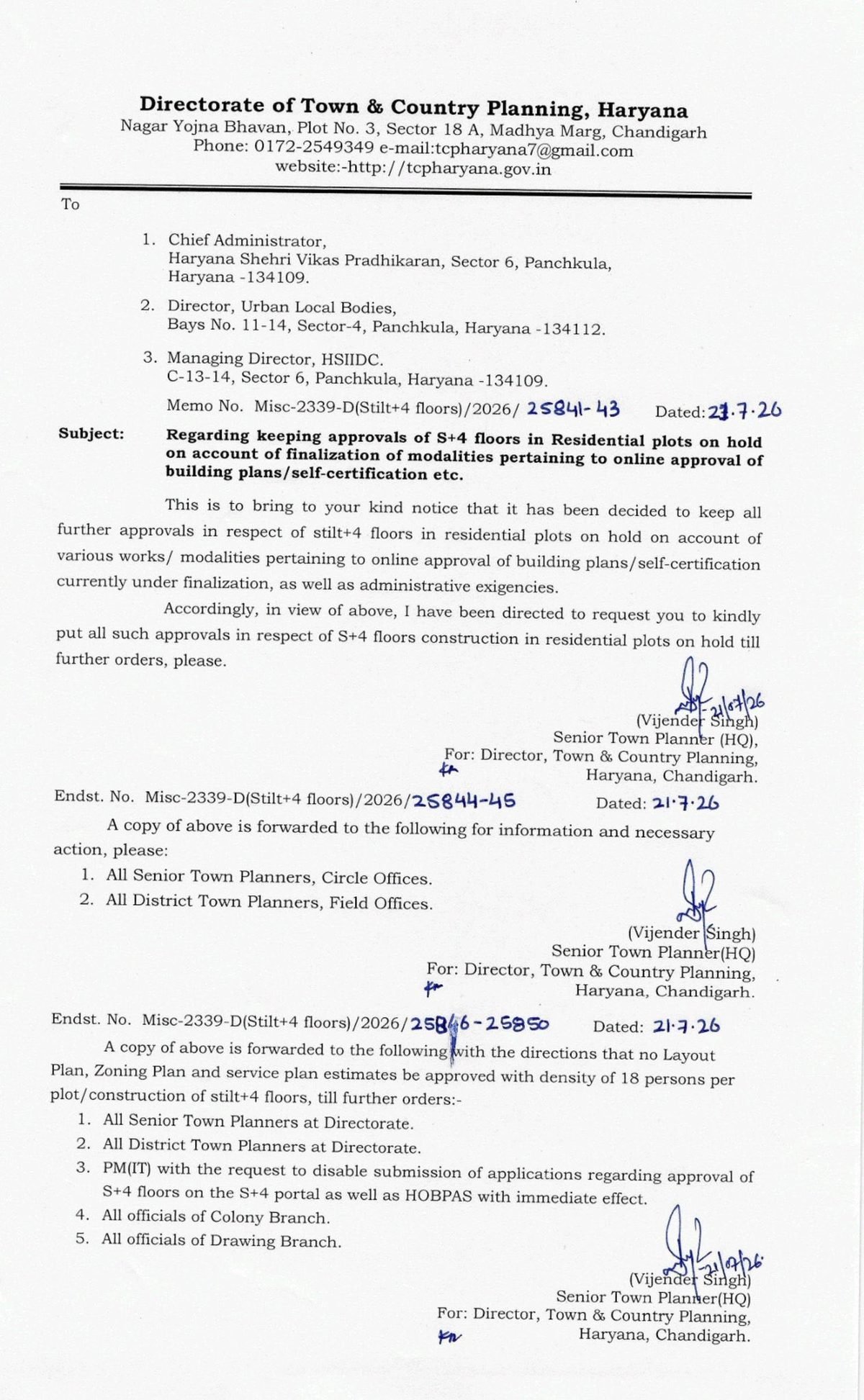
On 21 July 2026, the Directorate of Town & Country Planning, Haryana issued the memo that changes things on the ground right now:
Memo No. Misc-2339-D(Stilt+4 floors)/2026/25841-43, dated 21 July 2026, signed by Senior Town Planner (HQ) Vijender Singh for the Director, TCP.
It directs the Chief Administrator (HSVP), the Director (Urban Local Bodies) and the Managing Director (HSIIDC) to keep all further S+4 approvals in residential plots on hold till further orders.
The endorsements go further. No Layout Plan, Zoning Plan or service plan estimate is to be approved with a density of 18 persons per plot or S+4 construction, and the IT wing was directed to disable the submission of S+4 applications on both the S+4 portal and HOBPAS — the Haryana Online Building Plan Approval System — with immediate effect. The stated reason: modalities around online approval of building plans and self-certification are still being finalised, plus “administrative exigencies.”
So what’s the real status today?
Fresh S+4 approvals are frozen. The policy is stayed, not repealed. Nobody has been told their existing legal building will be demolished — but the tap for new approvals is shut, and the online systems are switched off.
In my years across Gurugram, I’ve learnt to read the actual order — not the WhatsApp forward. “On hold till further orders” is not “banned forever.” It’s a pause button, not a delete button.
But a pause can last months, and while it lasts, nobody gets a fresh S+4 plan sanctioned. So if your entire purchase depends on that sanction coming through, you’re now waiting on a court and a department — not on a builder’s promise. Plan accordingly.
What this means if you’re mid-decision
If you were about to buy a builder floor — especially a 4th floor, or on a plot fronting a narrow road — this is exactly the moment to slow down and verify approvals before you pay a token. Road width has long been the make-or-break eligibility factor for S+4, and banks were already cautious on top-floor units where that box wasn’t cleanly ticked.
If you already own, you’re most likely fine — but keep your sanctioned plan, occupancy certificate and stilt-usage compliance clean, because the enforcement drive against stilt misuse and road encroachment is live right now.
My honest advice hasn’t changed in a decade: never pay a token on a floor whose approval you haven’t physically seen. Not the builder’s word — the sanctioned plan, the OC, the road width, on paper.
In this climate that discipline isn’t caution. It’s the difference between an asset and a liability.
One honest caveat
Not sure if a project or floor is safe to buy right now?
That’s exactly the verification I do before any client of mine signs anything.
Apex Landbase — HARERA Reg. Agent EXTENSION-1/2024/289 | Firm HRERA-PKL-REA-1154-2022